
The importance of strength to a healthy lifestyle has been recognized for centuries – even for regular, non-athletic adults. As early as 3600 BC Chinese emperors actually required all subjects to exercise daily, and military recruits were required to pass additional strength tests such as carrying heavy stones.
Artifacts and early texts from Greek, Roman, and Egyptian civilizations also show that strength was an almost universally accepted necessity of life. Not only for day to day needs but also for warfare, competition, and even art.

In more recent times, the fascination with strength could be found in the exploits of circus and vaudeville strong men in the late 1800s and early 1900s, several of whom e.g. Eugen Sandow and Arthur Saxon actually published books on strength training.
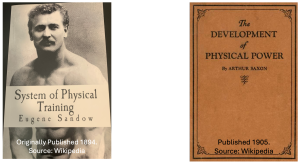
Others, notably Bernarr Macfadden, developed a system of strength training that he referred to as “Physical Culture” – presenting it as a lifestyle approach vs simply “exercising”. His “Physical Culture” magazine was first published in 1899.

Physical Education and strength exercise gradually became an accepted subject in schools, with programs that developed out of the early work of pioneers such as Dudley Sargent. This nineteenth-century fitness educator, inventor, and advocate was one of the first creators of systematic methods for mechanized physical training – what we would call “weight training machines” these days
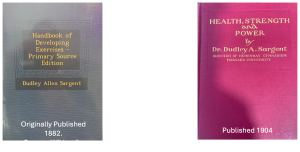
As Director of the Hemenway Gymnasium at Harvard University (1879-1019) he designed dozens of strength training machines and codified a system of training aimed at developing what he called a “balanced physique”. In other words a “whole body’ approach vs the then current focus on feats of strength for specific lifts and muscle groups.
While these approaches were, essentially, experiential/trial and error, the benefits of strength training as experienced and explained by those early “Strength Athletes” and “Physical Culture” advocates undoubtedly laid the foundations for the earliest research-based investigations.
One of the first actual research papers on strength training was published in 1894. In what would be called a “Case Study” today, it involved two adult female subjects who completed 2 weeks of grip strength training with their right hand only. This study demonstrated the occurrence of what came to be called “cross-training” (i.e. training only the right hand also produced strength gains in the untrained left hand).
Current and Ongoing Research
Since that first paper, thousands of strength training studies have been published over dozens of research areas (Kraemer et al., 2017) with tens of thousands of participants and a wide variety of training modes.
The vast majority of these studies found (and new studies continue to find) that an appropriately designed strength training program is safe and beneficial for healthy adults.
Since the 1970s the American College of Sports Medicine (ACSM) and the National Strength and Conditioning Association (NSCA) have issued, and regularly updated a series of “Guidelines” and “Position Stands” on resistance training for all ages, further establishing this mode of exercise as beneficial to health and wellness.
Additionally the ACSM recently published a highly relevant paper entitled “The Coming of Age of Resistance Exercise as a Primary Form of Exercise for Health”.
Key Research Findings

Safety

As well as the Guidelines and Recommendations cited above, a series of studies and surveys, including by the WHO, have consistently reported the safety of resistance training programs in healthy adults.
Performance Benefits

A comprehensive review on Resistance Training for Health and Performance reported improvements in a range of factors involved in sports performance, not simply limited to strength and muscle mass increases. Such factors included vertical jump, speed balance, coordination, and throwing velocity.
Health Benefits

Major reviews of the literature have consistently associated resistance training with reduced risk of all-cause mortality, as well as for a range of major non-communicable diseases including CVD, cancer, diabetes and lung cancer. Other reported benefits of resistance training include reduced blood pressure and improved sleep, as well as lower levels of depression and anxiety.
Lifestyle Benefits

The well documented effects of resistance training on strength, muscle mass and functional fitness, are also associated with beneficial effects on lifestyle daily activities including balance, reduced fall risk, gait speed, stair climbing, rising from a chair, carrying groceries, etc. Resistance training is becoming recognised as a form of exercise that may be a necessity for healthy living.
Take Home Message

Research has shown that resistance training is safe and beneficial for healthy adults. It builds a foundation of strength and muscle mass; preserves and/or increases functional independence; reduces risk of chronic diseases and improves mental health.